

Starting a Business to Find Your Happiness: The Story of Shared Cultures
Conversation with Eleana Hsu, Founder of Shared Cultures


There are some food makers you meet and you just know—they didn’t choose their craft so much as it chose them. Eleana Hsu, founder of Shared Cultures, is one of those people. Her San Francisco-based fermentation studio makes some of the most thoughtful, ingredient-driven misos and koji products I have ever tasted, and the story of how she and her partner, Kevin Gondo, have grown the business is one I knew I needed to share.
I met Eleana originally at a gift show and have been a fan of her products ever since. We recently sat down for a wide-ranging conversation about foraging, fungi, fermentation, and what happens when you stop climbing someone else’s ladder and start following your own joy.
The Mushrooms Found Her First
Eleana did not set out to start a fermentation business. She spent most of her twenties in desk jobs—paralegal work, then a master’s in real estate development and a position at a major commercial real estate firm. It was a path that looked impressive on paper but felt hollow in practice.
“I was severely depressed, trying to show up to work with a smile on my face. I had to go for runs before and after work just to get that serotonin.”
On one of those early morning runs near her home in Palo Alto, she spotted something that stopped her in her tracks: a cluster of bright yellow, goofy-looking mushrooms growing on the hillside.
“They kind of reminded me of daffodils or sunflowers, but in mushroom form,” she says. She didn’t know what they were at the time. She just knew they made her happy. She stuffed them into her shirt pocket and headed to the library to find out more. They were chanterelles—the very same chanterelles she’d been eyeing at the Palo Alto Farmer’s Market just the week before.
From that moment, mushroom foraging became her medicine. The more she explored and discovered, the better she felt. But the discovery sparked a question: what to do with everything she was collecting? Simply picking mushrooms and letting them go to waste felt wrong. So she went back to the library, checked out every book on food preservation and fermentation she could find, and taught herself about koji.
“I learned that mushrooms have protein, and I can ferment the protein using koji to turn it into amino acids—which gives us umami. That’s really how Shared Cultures started.”
What Is Koji, and Why Does It Matter?
For those unfamiliar with koji (Aspergillus oryzae), Eleana is one of the best teachers you could ask for. She has a way of making the science feel both precise and delicious.
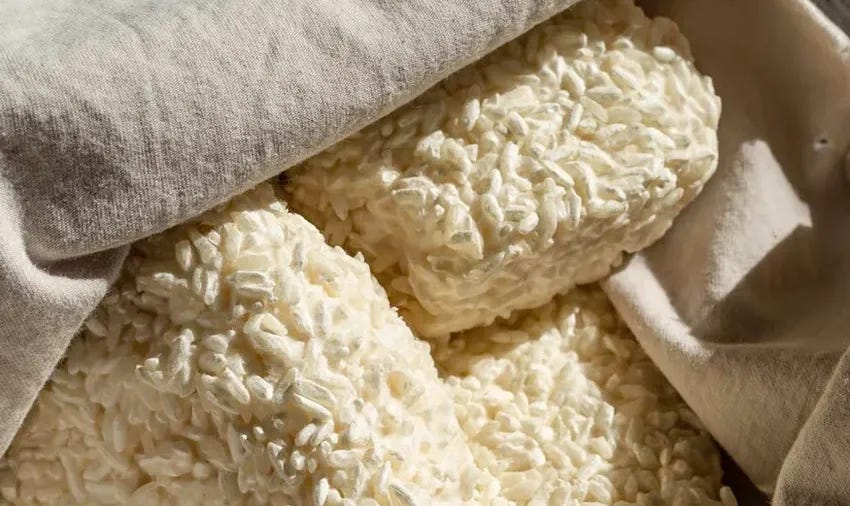
“Koji is actually a fungi,” she explains. “Like all fungi, it secretes enzymes. It produces two key types: amylase, which breaks down starches into sugars, and protease, which breaks down proteins into amino acids—what we taste as umami. That’s why there’s no added sugar in our misos. The koji is creating natural sweetness from the starches in the rice and umami from the protein in the beans.”
One of her favorite moments when tabling at markets is watching people pick up a jar and scan the label, certain they’ll find sugar.
“They look and look and can’t find it. It’s not there. Because the koji is making it.”
Beyond flavor, the fermentation process makes nutrients more bioavailable. Eleana and team are meticulous about ingredients—they source Rancho Gordo beans, use the freshest seasonal produce, and work with the best rice they can find. “I do believe that the quality of the ingredients when fermented produces something that is very, very healthy. There’s just no way it isn’t.”
Foraging as a Business Value
Six years in, foraging is still a core part of what Shared Cultures does—not just as a sourcing strategy, but as a company value. Eleana takes her whole team out on a three-cornered leek foray when in season, and regularly goes out for mushrooms.
Her introduction to three-cornered leeks came through a book recommendation: The Bay Area Forager by Mia Andler and Kevin Feinstein. “I read about them and went out, identified them, ate one on the spot, and thought—this tastes just like a ramp.” (The comparison makes sense: three-cornered leeks are in the same allium family, but they grow wild throughout the Bay Area, no cross-country shipping required.)
I asked her what other things she’s still foraging for today:
“Chanterelles almost year-round—there are spring, summer, and fall varieties. Morels in May up near Shasta. Black trumpets, hedgehog mushrooms, matsutake. For our wild mushroom misos, every single batch has at least a touch of something we collected ourselves.”
She partners with Far West Fungi in San Francisco for larger volumes of wild mushrooms, whose forager network sources throughout the Pacific Northwest. But the team foray is never skipped.
“It’s the celebration of seasonality. It’s also how we infuse the joy of making back into the process,” she says. “When you’re in the weeds all the time, your creativity gets dampened. Getting out into the forest is a reset.”
Salt Born from Beautiful Flowers
Shared Cultures makes two salts, and both grew directly out of the fermentation work. The story of how they came to be is a perfect example of Eleana’s instinct to honor every part of an ingredient.


When processing three-cornered leeks for miso, she found herself with a pile of flowers she couldn’t bring herself to blend away. The blossoms were too lovely to lose.
“I thought—wouldn’t it be fun to ferment the flowers? So we separate them from the stalks, ferment the flowers and greens together using shio koji for about two weeks, then dehydrate everything. We make sure the flowers stay completely intact so you can actually see them in the jar.”
The result is the Wild Foraged Leek Salt: a salt that carries real koji umami from fermentation, dotted with preserved allium flowers. It’s one of my personal favorites to use on simple dishes—eggs, roasted vegetables, avocado toast. I also add it to anything I’m already using leeks in, to add depth of flavor.


The second salt is a Porcini and Black Garlic Koji Salt, and its origin is equally resourceful. When Shared Cultures presses their lentil-and-quinoa shoyu (a soy-free soy sauce, fermented for a year and a half), the resulting mash—instead of being discarded like traditional wheat-based lees—gets dehydrated and folded into the salt blend with foraged porcini and black garlic. This jar is more seasoning than salt. It’s a small miracle of food waste minimization. Coming to A Dash Of in the fall.
One tip I always share at tastings: get your seasoned salts out of the cabinet and onto the counter. Swap them out every few weeks, but use them regularly. Just like dried herbs and other spices, the aroma is much of the magic, and these are meant to be used within a year from purchase for the best experience.
What’s Coming Next
Eleana is not short on ideas. She recently hired Shared Cultures’ second employee, which means more experimentation bandwidth than she’s had in years.
The ferment she’s most excited about right now: a yuzu miso. A customer with a yuzu tree in her Berkeley backyard generously let Eleana forage the entire thing this past December. They just pulled the R&D batch off the shelf and tasted it for the first time.
“We micro-planed the rind right in. Oh my God. It is just amazing.”
She’s also working on what she calls an “Asian mirepoix” miso—garlic, ginger, and scallion—inspired by the flavor base her parents cooked with throughout her childhood. It’s a natural companion to the mirepoix miso already in her lineup (which I can personally vouch for; I have an unlabeled jar of it in my refrigerator from the Good Food Awards blind tasting, but purchase this one regularly).
And in a collaboration she’s been quietly dreaming about for years: Shared Cultures is now R&Ding flavors with Rose Los Angeles, a cannabis gummy company known for its ingredient-forward approach. “Three or four years ago, I thought that would be my dream collaboration. And then they reached out.”
Finding Your Flavors
One of the things I love about talking to Eleana is the way she thinks about consumer education. Her products can feel unfamiliar to people who’ve never cooked with koji—but the fix isn’t simplifying. It’s connecting.
They also run monthly two-hour fermentation workshops at their space—and Eleana is toying with a shorter, guided tasting format as well. (I may or may not have offered to help design the tasting flight format. We shall see.)
In restaurants, you’ll find Shared Cultures misos at Restaurant Greens in Fort Mason (Chef Katie orders by the bucket—truly the dream) and at Pomat in Oakland, where their miso appears on a pasta dish.
A Dash Of Reflection
What I keep coming back to in Eleana’s story is this: she wasn’t looking for a business. She was looking for relief. The mushrooms offered it. The fermentation followed. The business grew out of genuine joy, and you can taste that in the products.
“You can experience flavors that fine dining chefs are experimenting with in their kitchens—unlocked through fermentation—for $20 a jar. Not all of us can get a reservation at those places.”
That feels very much in the spirit of what A Dash Of is about: bringing exceptional ingredients and the stories behind them directly to your table. Shared Cultures does exactly that.
You can find Shared Cultures salts in the A Dash Of shop, and explore their full umami lineup at shared-cultures.com. Follow them at @sharedculturessf. And if you get the chance to take one of Eleana’s workshops—go.
Loved the JOY in this article. Very interesting too!
Fantastic read!!